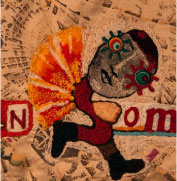
Why do you call your creations "sewn
drawings"?
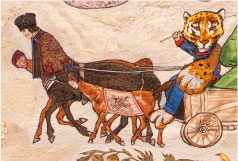
Because the industrial zig-zag sewing machine
I draw with has only one stitch, a mechanized version of an
artist's scribble, which can scumble or lay in solid color
or thin into a line; because I have drawn all my life in a
great variety of media, and now that I'm drawing with a sewing
machine, there's no reason to call it anything else; and because
drawing/sewing is the primary transformative agent that over
days and weeks turns scraps of patterned fabric into works
of art.
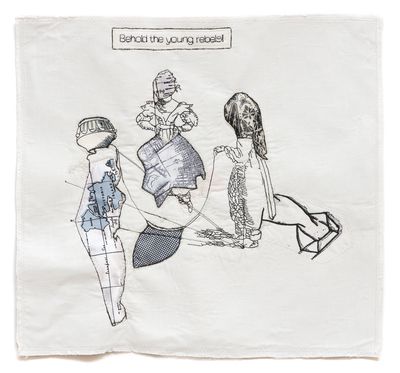
How do you think of the things that appear
in your drawings? You must have a wonderful imagination…
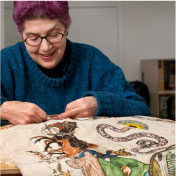
Process generates the imagery. I just have
to show up and do the work. I start by moving around scraps
of patterned fabric and paying close attention to what is happening
under my hands. When something interesting comes together,
I lay it on another printed fabric and sew into it. I keep
sewing, making changes, picking out stitches, pulling off pieces
of fabric and sewing down new scraps, sometimes even cutting
the whole thing apart and reconstructing it, all in the service
of the process, groping toward something I've never seen before.
Where do you find the printed fabrics you
use in your sewn drawings?
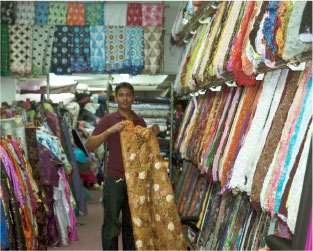
I shop in discount fabric stores all over
Manhattan, Queens, and Brooklyn, seldom buying more than a
yard at a time or paying much more than $10 a yard, usually
without having any idea of what I'm going to do with it. Second-hand
clothing stores sometimes have very nice things—there
is more than enough fabric in a printed blouse for my purposes.
Whenever I travel to another city, I try to visit fabric stores
and vintage clothing shops, where I sometimes find wonderful
things. After my sewn drawings were first shown, people started
giving me pieces of fabric and trim. Mickey Kreuger of Windham
Fabrics invited me to his warehouse in Jersey City to choose
anything I wanted. It is a greater challenge to find thread.
No matter how many spools and cones of thread I already have,
I am always trying to match a particular color in a fabric
that is part of a new drawing. I buy whatever I can find, industrial
cones, Coats & Clark, Metrosene, and Gutterman spools,
off-brands and surplus—polyester, poly-cotton, cotton,
and silk.
How long does it take you to make one of
your drawings?
Weeks or months, depending on size and complexity.
For every hour I spend sewing, I spend another two hours drawing
threads back, one by one, tying them off to the bobbin threads,
and trimming the excess. For example, it takes about fifteen
hours to do five hours of sewing. And since I never know what
the finished drawing is going to look like until very late
in the process, I invariably spend a lot of time revising,
undoing, re-doing, and repairing collateral damage. Fortunately,
sewing/drawing is the most interesting and compelling thing
I have ever done, and no amount of trouble is too much.
Have you been sewing all your life?
I hated sewing. In Seventh Grade Home Economics,
each of us girls had to make a skirt. I selected the fabric,
a turquoise paisley in polished cotton, but refused to sew
a skirt from it. After my mother made the skirt for me so that
I wouldn't flunk the class, I refused to wear it. I had only
a vague idea of how to use a sewing machine when I started
to make sewn drawings. But I was trained and worked for many
years as a sculptor, using all kinds of hand and power tools.
An industrial sewing machine is just another power tool, one
that I draw with. I still have absolutely no interest in making
curtains or clothing.
How can I see your work?
Click on News to learn of current and future
shows featuring my sewn drawings or contact the Luise Ross
Gallery at www.luiserossgallery.com to arrange a visit. |